Onir Resources
Cut Back on Thanksgiving Drinking This Year
Drink less at Thanksgiving without anyone noticing. November 2026 tips on pacing, deflection lines, and setting a limit before you arrive.

By Justine Fowey, Onir Health Editorial Team
· Updated

You're not dreading the food this Thanksgiving. You're dreading that stretch between 2 p.m. and dessert where drinks just keep appearing and saying no feels like it needs a press release. It doesn't have to be that complicated. A few small, private moves can cut your total in half without anyone at the table noticing.
TLDR:
- 55% of Americans drink more than usual on holidays, and the six-hour Thanksgiving timeline is a big reason why
- Set a specific drink number before you arrive and alternate each one with a non-alcoholic option to cut your total in half
- Keep a full glass of something (ginger beer, sparkling cider) in your hand so no one offers a refill or asks questions
- Fewer than 3% of people with alcohol use disorder get medication like naltrexone, mostly because they've never heard of it
- Onir prescribes naltrexone at $99/month with no insurance billing, available in all 50 states
Why Thanksgiving Drinking Creeps Up on You
Thanksgiving starts early and ends late, which is part of the problem. By the time you sit down for the actual meal, you may already be three glasses deep because someone opened a bottle of wine at noon and it just kept circulating. The day stretches across six or eight hours of family time, and for a lot of people, a drink in hand is the default way to fill the gaps between football, cooking, and small talk with relatives you see once a year.
Family stress compounds it. You're back in old roles, fielding questions about your job or your relationship status, stuck in dynamics that haven't changed since you were seventeen. A refill feels like the path of least resistance, and nobody's counting yours because they're not counting their own.
You're far from alone in this. According to a survey of 1,000 people, 55% of Americans drink more than usual on holidays, with that figure climbing to 65% for Gen Z. The same data found that roughly 69% of respondents say the stretch between Thanksgiving and New Year's is when they're most likely to overindulge. That pattern isn't a character flaw. It's a predictable collision of long gatherings, open bottles, and social momentum that makes moderation genuinely hard, even for people who manage it fine the other eleven months of the year.
Set a Personal Limit Before You Arrive
Deciding on a number before you walk through the door is the single most effective thing you can do. Not a vague intention like "I'll take it easy." An actual number. Two drinks, three drinks, whatever feels right for you. The specificity matters because it gives you something concrete to measure against when your uncle is topping off glasses and the evening still has three hours left.
Pick that number with the length of the day in mind. If you're arriving at 1 p.m. and dessert won't wrap until 7, spacing two drinks across six hours looks very different than cramming them into the first ninety minutes. A good rule of thumb: divide the total hours by your drink count, then pad each gap with a glass of water or sparkling cider. You stay hydrated, you keep something in your hand, and you avoid the awkward pause where someone rushes to refill your empty glass.
Pre-commitment works better when it lives outside your head. A few ways to anchor it:
- Write the number in your phone's notes app where you'll see it when you check the time
- Text it to a partner or friend who's also at dinner so you have quiet accountability
- Set a silent alarm for the halfway mark as a check-in with yourself
None of these require an announcement. The goal is a private system that cuts the urge to drink before "one more won't hurt" kicks in. If you hit your number and the night is still young, switch to something non-alcoholic. You'll be surprised how quickly the urge passes once the decision is already made.
What to Say When Someone Asks Why You're Not Drinking
Most of the awkwardness around not drinking comes from the explanation, not the decision itself. A ten-word answer gets a nod. A two-minute justification gets follow-up questions, unsolicited opinions, and your aunt's story about her neighbor who "had a problem." The less you say, the less there is to latch onto.
The NIAAA's Rethinking Drinking resource recommends a "recognize-avoid-cope" approach for handling drink pressure in social settings. Keep your responses short, casual, and closed-ended:
- "I'm pacing myself today."
- "I'm good with this for now."
- "I'm driving later."
- "Trying something different this month."
Confidence matters more than the words. Say any of these like it's boring, and it becomes boring. People mirror your energy. If you treat it as a big reveal, they will too.
The strongest deflection is already having a drink in your hand. A sparkling water with cranberry juice or a ginger beer in a tumbler looks identical to a cocktail from across the room. When your glass is full, nobody walks over with a bottle. The question never comes up, which means you never have to answer it.
Keep a Non-Alcoholic Drink in Rotation
Having something in your glass is the strategy. When you're holding a tumbler of sparkling apple cider or a ginger beer over ice, the refill patrol passes right by you. Nobody interrogates a full glass.
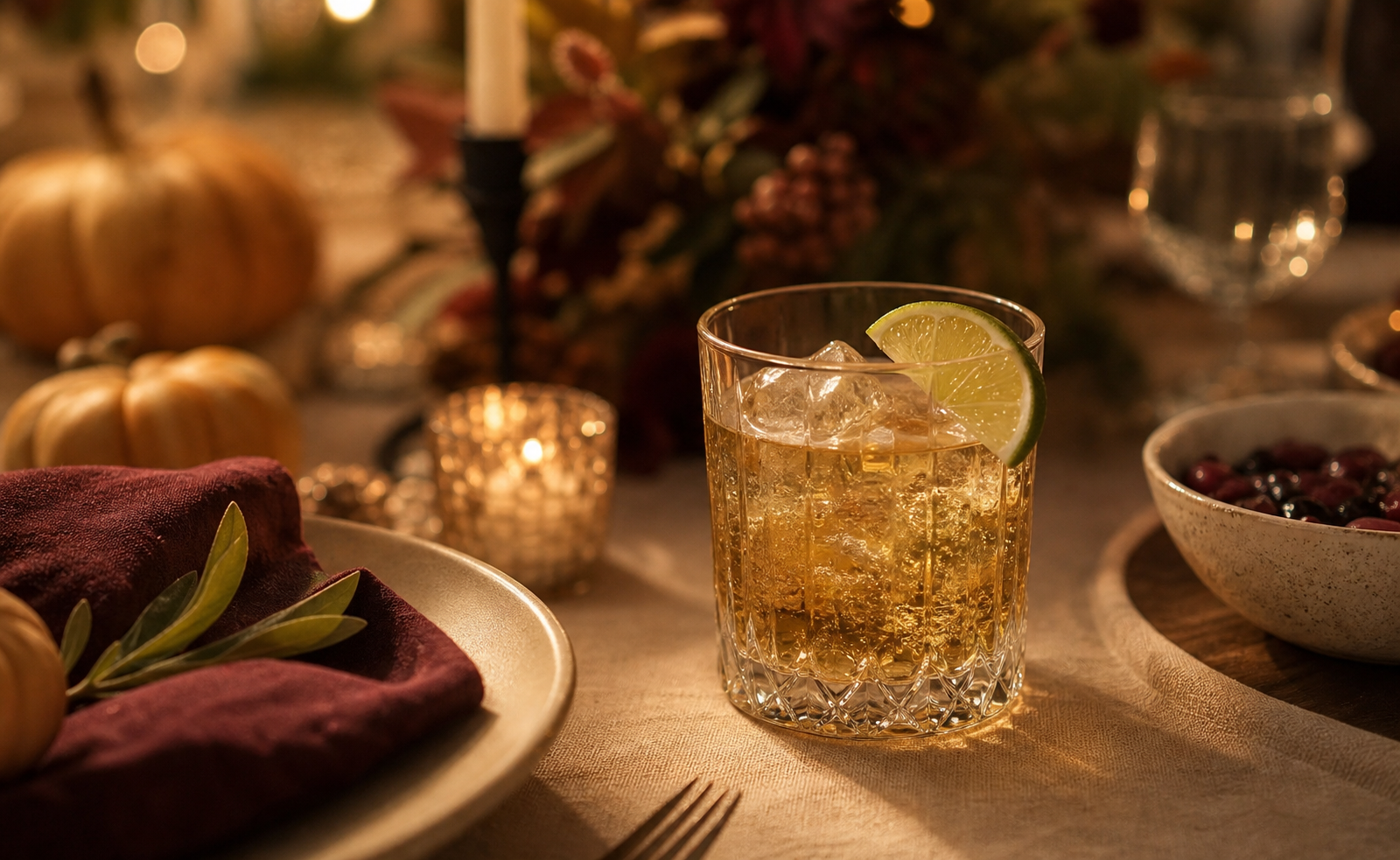
The real power of a non-alcoholic drink at Thanksgiving dinner is pacing. Alternate one alcoholic drink with one NA option and you cut your total roughly in half over the course of the meal without ever saying no to anything. Your uncle pours a round of bourbon, you join in. Then you switch to sparkling water with a splash of cranberry for the next forty-five minutes. By dessert, you've had two or three drinks instead of six, and no one tracked the difference.
A few options that feel like they belong on the table:
- Apple cider with a cinnamon stick and sparkling water, served in the same glassware everyone else is using
- Ginger beer in a rocks glass with a lime wedge, which reads as a cocktail without explanation
- NA beer, if your host stocks it (bring your own to be safe)
- Hot cranberry juice with cloves, served in a mug alongside the after-dinner coffee
Pick something that looks intentional, and keep it within arm's reach so the gap between drinks never looks empty enough for someone to fill.
Pacing Strategies That Work at a Long Holiday Meal
Thanksgiving dinner unfolds in stages, and each one comes with its own pour. There's the pre-meal glass while someone carves the turkey, wine during the actual sit-down, and then a bourbon or dessert wine once the plates are cleared. Across a six-hour gathering, six drinks might not feel like a lot in the moment, but your body metabolizes roughly one standard drink per hour. Six drinks over six hours keeps your blood alcohol at a steady, persistent level. You never feel drunk enough to stop, but you never quite return to baseline either.
Eating helps more than people realize. Food slows alcohol absorption, and Thanksgiving practically forces a big meal. Eat something substantial before your first sip. If the turkey isn't ready until 4 p.m. and drinks start at 2, grab a plate of appetizers first.
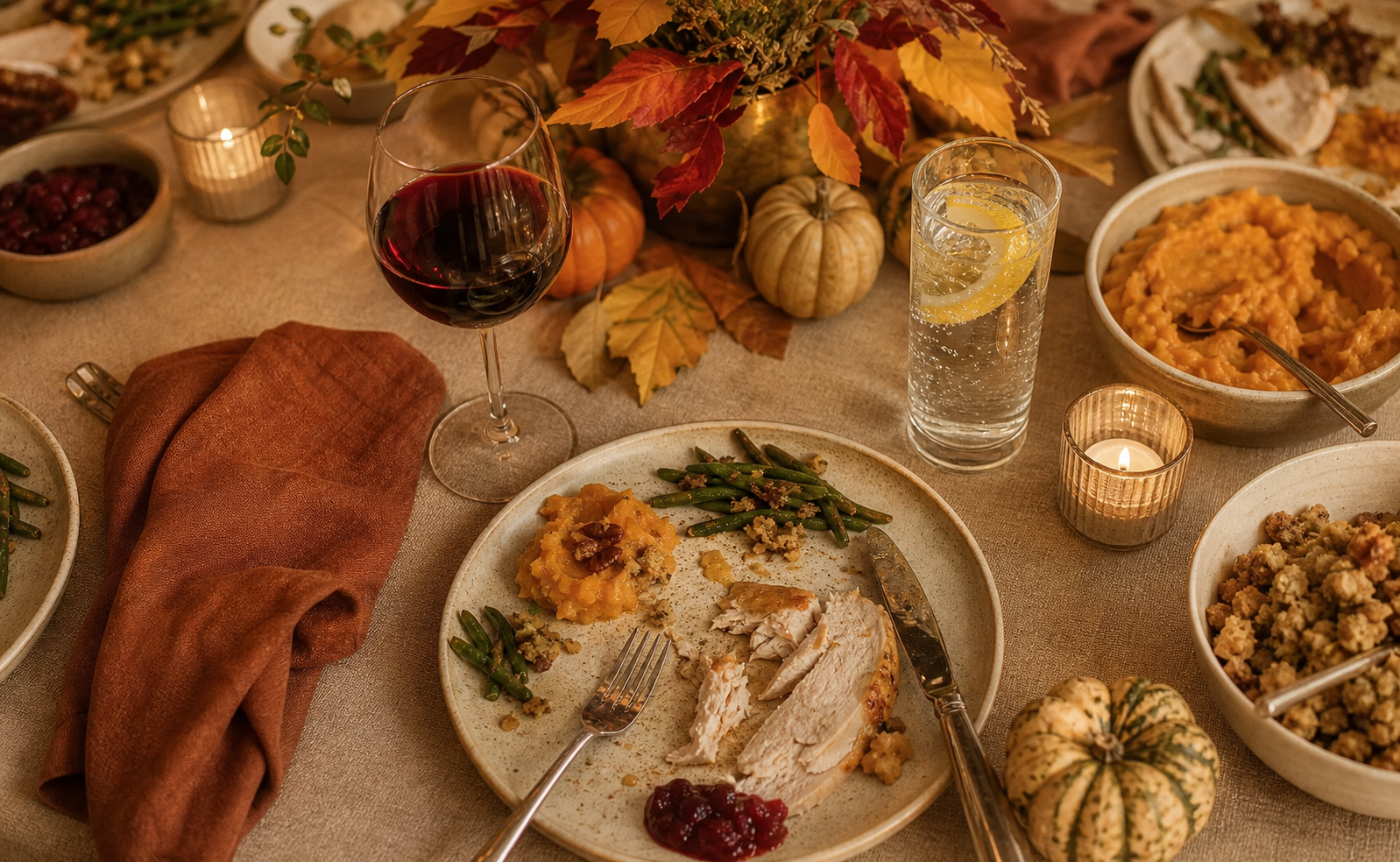
A few pacing tactics that work without drawing attention:
- Set a minimum of 45 minutes between drinks, timed on your phone if needed
- Sip slowly enough that you're never the first person with an empty glass
- After dinner, switch entirely to coffee, tea, or a hot non-alcoholic drink with dessert
- Fill your water glass every time you sit back down at the table
The refill trap at family dinners is automatic. Someone circles with a bottle, tops you off at the halfway mark, and suddenly your "two glasses of wine" became four because the glass was never actually empty. Keep your hand over your glass or set it out of easy reach when you're not actively drinking. Small, deliberate friction makes a real difference over a long afternoon.
Recognize the Pattern: When Holiday Drinking Reflects a Bigger Habit
If the strategies in this article feel useful for Thursday but unnecessary by Monday, this section probably isn't for you. But if reading about Thanksgiving drinking made you think about Tuesday nights, or last weekend, or the bottle of wine that's become a nightly default, it's worth sitting with that for a minute.
About 28.9 million Americans aged 12 and older have alcohol use disorder, yet fewer than 3% received any FDA-approved medication for it in the past year. That gap isn't because people don't want to change. It's because the pattern doesn't always look like what we've been taught a "drinking problem" looks like. It can look like two glasses of wine every single night, or always being the one who suggests a second round, or realizing you haven't gone a full week without a drink in months.
Habitual drinking works on a neurological reward loop. Alcohol triggers a wave of endorphins, your brain registers that as a reward worth repeating, and over time the decision to pour another glass stops feeling like a decision at all.
The holiday isn't the cause. It's the setting where the volume gets turned up loud enough to notice. If your concern about Thanksgiving drinking is really a concern about how you drink in general, that recognition is a starting point, not a verdict.
Prescription Options for Reducing Drinking Without Rehab
Most people who want to cut back on drinking assume the options are willpower or rehab. There's a wide middle ground that rarely gets talked about. Three FDA-approved medications exist to help people reduce alcohol use: naltrexone, acamprosate, and disulfiram. None of them require inpatient treatment, group meetings, or even an in-person doctor visit.
Medication | How It Works | Form | Key Detail |
|---|---|---|---|
Naltrexone | Blocks opioid receptors so alcohol's endorphin-driven reward signal is muted | 50 mg daily oral tablet or 380 mg monthly injection (Vivitrol) | FDA-approved for over 30 years; non-addictive and non-habit-forming |
Acamprosate | Stabilizes brain chemistry disrupted by chronic alcohol use, reducing post-withdrawal cravings | Oral tablet, typically taken three times daily | Most effective for people who have already stopped drinking and want to maintain abstinence |
Disulfiram | Causes unpleasant physical reactions (nausea, flushing) when alcohol is consumed, creating an aversive deterrent | Oral tablet, taken once daily | Requires full abstinence; drinking on it produces immediate, uncomfortable side effects |
Naltrexone is the one worth knowing about first. When you drink, your brain releases endorphins that activate opioid receptors, creating a reward signal that reinforces the behavior. Naltrexone blocks those receptors. The drink still tastes the same, but the neurological payoff is muted, so the pull to keep going or to pour one again tomorrow gradually weakens. It comes as a 50 mg oral tablet, taken daily or before drinking, and as a monthly 380 mg injection (brand name Vivitrol), details covered in this naltrexone dosing guide. The oral form has been FDA-approved for alcohol use disorder for over 30 years, and most people notice results within a predictable window (see our naltrexone work timeline). It's non-addictive and non-habit-forming.
The real barrier is awareness. Most people have never heard of these medications, and most primary care doctors don't bring them up unless asked. Telehealth services offering medication to cut back on drinking have started to close that gap by letting a licensed clinician review your history, prescribe if appropriate, and ship medication to your door without a waiting room or a label you didn't ask for.
Keeping It Private: Employer and Insurance Concerns
Privacy is the first filter for a lot of people considering help with drinking. Before they research medications or compare programs, they want to know one thing: will this show up somewhere it shouldn't?
Self-pay telehealth keeps treatment off your insurance records entirely, though it helps to understand the naltrexone cost without insurance beforehand. No claim gets filed, no explanation of benefits lands in your mailbox, and your employer's HR department never sees a line item. Federal law adds another layer: under 42 CFR Part 2, substance use disorder treatment records carry extra protections beyond standard HIPAA rules. They generally cannot be shared with anyone, including other healthcare providers, without your explicit written consent.
One nuance worth knowing: when a prescription is filled at any U.S. pharmacy, it gets recorded in the national e-prescribing network (Surescripts). Doctors' offices routinely pull medication histories from that network, so a filled naltrexone prescription could appear on a medication list at a future appointment, even if nothing went through insurance. Self-pay keeps treatment off insurance, but not off pharmacy medication history. If a doctor sees it later and you're no longer taking it, their office can mark it "discontinued" in your chart, which is a separate question from whether naltrexone shows up on a drug test.
None of this requires walking into a clinic, sitting in a waiting room, or telling your employer anything.
How Onir Helps People Who Want to Drink Less
If the tips earlier in this article feel like enough for you, that's great. But if you recognized something familiar in the section about patterns, where the habit extends well past the holiday, Onir might be worth a look.
We built Onir, one of several Oar Health alternatives worth comparing, for people who want to drink less (or stop entirely) without upending their daily life. A licensed clinician reviews your history and, if appropriate, prescribes naltrexone, the FDA-approved medication that blocks the neurological reward loop that keeps drinking feeling automatic. If it isn't the right fit, alternatives to naltrexone exist too. Most members notice the pull weakening within 10 to 14 days, a pattern echoed across Onir member reviews.
The process is simple:
- A free 60-second quiz to see if you're a fit
- A $19.99 clinician review, refunded in full if you're not approved
- $99 a month, billed as $297 every 90 days, with medication and clinician care included
Onir is available in all 50 states, and naltrexone user reviews reflect how members experience that. Medication ships in plain, unmarked packaging. We don't bill insurance, so there's no claim record. And we never contact your employer or your primary care doctor unless you ask us to. It's a private, quiet way to change a habit that stopped feeling optional a while ago.
Final Thoughts on Keeping Your Thanksgiving Drinking in Check
The day is long, the bottles are open, and nobody's counting for you. That's exactly why a simple plan works so well. Pick your number, keep something in your glass, and give yourself permission to stop when you said you would.
FAQ
Is there a prescription option to help me drink less without going to rehab?
Yes. Three FDA-approved medications exist for reducing alcohol use without inpatient treatment: naltrexone, acamprosate, and disulfiram. Naltrexone is the most widely prescribed, available as a daily 50 mg tablet or a monthly injection, and can be prescribed through telehealth services like Onir without an in-person visit or waiting room.
What is naltrexone and how does it help with drinking less?
Naltrexone is a non-addictive, FDA-approved medication that blocks the opioid receptors activated when you drink, muting the endorphin-driven reward signal that makes alcohol feel automatic. Over time, the pull to keep drinking or to pour another glass the next day weakens because the neurological payoff is no longer there. It's been FDA-approved for alcohol use disorder for over 30 years and comes as a daily oral tablet or monthly injection.
What tools should I use if I want to cut back on drinking but keep it private from my employer?
Self-pay telehealth services keep treatment entirely off your insurance records, so no claim is filed and no explanation of benefits reaches your mailbox or your employer's HR department. Federal protections under 42 CFR Part 2 add a second layer, preventing substance use treatment records from being shared with anyone, including other healthcare providers, without your written consent. Onir operates on a self-pay model, ships medication in unmarked packaging, and never contacts your employer or primary care doctor unless you ask.
How can I actually drink less at Thanksgiving without making it obvious?
The most effective move is keeping a non-alcoholic drink in your hand between rounds. A sparkling apple cider with a cinnamon stick or ginger beer in a rocks glass reads as a cocktail from across the room, which means no one walks over with a bottle and no one asks questions. Pair that with a specific number decided before you arrive and a 45-minute minimum between alcoholic drinks, and you can cut your total roughly in half over a long holiday meal without anyone tracking the difference.
How do I know if my Thanksgiving drinking habit is part of a bigger pattern?
If your concern about holiday drinking also applies to Tuesday nights, weekends, or the bottle of wine that's become a nightly default, that recognition is a starting point worth paying attention to. About 28.9 million Americans have alcohol use disorder, yet fewer than 3% receive medication to help. If you haven't gone a full week without a drink in months, or the decision to pour another glass stopped feeling like a decision, Onir's free 60-second quiz can help you figure out whether medication support fits your situation.
Why is the night before Thanksgiving considered the biggest drinking night of the year?
Thanksgiving eve drinking surges because millions of people return to their hometowns, reconnect with old friends at local bars, and have no work the next morning. The combination of nostalgia, free time, and social momentum makes the Wednesday before Thanksgiving one of the heaviest bar nights in the U.S., which often sets the tone for even more drinking on Thursday itself.
What are some easy hot thanksgiving drinks non alcoholic that feel festive at dinner?
Hot cranberry juice simmered with whole cloves and served in a mug works well alongside after-dinner coffee, and warm apple cider with a cinnamon stick and a splash of sparkling water feels intentional without requiring a recipe. Both look like they belong on the table and keep your glass full enough that nobody offers a refill.
Can I take naltrexone just on holidays like Thanksgiving, or do I need to take it daily?
Onir clinicians prescribe naltrexone as one tablet every day, not just on holidays, so it's already working when the surprise refill shows up. Your clinician reviews your history and builds the plan around your goal.
Best way to pace yourself at a six-hour Thanksgiving dinner without anyone noticing?
Set a minimum of 45 minutes between alcoholic drinks and alternate each one with a non-alcoholic option like ginger beer in a rocks glass or sparkling cider. Eat something substantial before your first sip, since food slows alcohol absorption, and keep your wine glass out of easy reach between sips so the refill patrol passes you by.
What are simple thanksgiving drinks for the family that work for both kids and adults?
An apple cider thanksgiving drink made with sparkling water, a cinnamon stick, and a splash of cranberry juice works for every age group and looks polished in regular glassware. Ginger beer over ice with a lime wedge is another option that reads as festive for adults and fun for kids, no explanation needed.
Should I tell my family I'm cutting back on drinking at Thanksgiving, or keep it to myself?
You don't owe anyone an explanation. Short, closed-ended responses like "I'm pacing myself today" or "I'm good with this for now" get a nod and move the conversation along. The strongest deflection is already having a full glass of something in your hand so the question never comes up in the first place.
How quickly does naltrexone start working if I want results before the holidays?
Most people notice the pull of alcohol weakening within 10 to 14 days of starting naltrexone, with improvements in sleep and energy often showing up in the first month. If you start before Thanksgiving, you may already feel a meaningful difference by the time the holiday arrives. Onir's clinician review typically happens within 24 hours of completing the intake.
How much does Onir cost compared to paying for naltrexone through my regular doctor?
Onir costs $99 a month, billed as $297 every 90 days, with medication and clinician care included. Through a regular doctor, you'd typically pay for the office visit, a separate pharmacy fill, and potentially higher out-of-pocket costs if your insurance doesn't cover naltrexone. Most Onir members save more than the program costs in the first six months from drinking less.
Drinking games for Thanksgiving keep coming up in my group chat — how do I opt out without being weird?
Treat it the same way you'd handle any drink refusal: keep it brief and boring. "I'm sitting this one out" or "I'll keep score" works without turning it into a moment. Having a non-alcoholic drink in hand lets you stay in the room and participate in the social energy without matching everyone glass for glass.
Will my doctor find out if I get naltrexone prescribed through a telehealth service like Onir?
Onir never contacts your primary care doctor unless you specifically ask. However, when any U.S. pharmacy fills a prescription, it gets recorded in the national e-prescribing network (Surescripts), which doctors' offices routinely pull medication histories from. Self-pay keeps naltrexone off your insurance records, but a future doctor could see it on a pharmacy medication list at a routine visit.
The science behind Onir has been covered by
82%
drinking less within two weeks
30+ yrs
FDA-approved & clinically studied
1,200+
clinical studies behind it
$99
per month, shipped discreetly
In their words
“I started my medication about 8 days ago. I feel amazing. Don't really have any urges to drink alcohol.”
Keep reading
Resources
How to Enjoy the Holidays While Drinking Less
Want to drink less this holiday season? November 2026 tips on pacing, mindful drinking, and naltrexone to ease the urge to refill.
ReadResources
Why Holiday Drinking Adds Up This December
Wondering why holiday drinks add up so fast? Learn practical ways to cut back on Christmas drinking this November 2026.
ReadResources
November 2026: Drink Less Without Quitting
Drinking less without quitting is a real goal. Get a November 2026 plan for setting rules, tracking habits, and staying social.
Read