Onir Resources
How to Enjoy the Holidays While Drinking Less
Want to drink less this holiday season? November 2026 tips on pacing, mindful drinking, and naltrexone to ease the urge to refill.

By Justine Fowey, Onir Health Editorial Team
· Updated

You didn't plan to have five drinks at last year's holiday party. Nobody really does. But between the open bar, the coworker handing you a refill, and the general permission slip that comes with "it's the holidays," your brain's reward system had about a dozen reasons to keep your glass full. If you want this season to go differently, it helps to understand why those nights spiral and what you can do at specific, predictable moments to change the outcome.
TLDR:
- About 55% of Americans drink more between Thanksgiving and New Year's
- Alcohol's reward loop speeds up at parties, making each refill feel automatic
- Set a drink limit before you arrive and alternate with water to cut your pace in half
- Naltrexone is an FDA-approved medication that weakens the urge to keep drinking
- Onir is self-pay ($99/month), so there's no insurance claim record
Why Holiday Drinking Creeps Up on You
Between Thanksgiving and New Year's, roughly 55% of Americans drink more alcohol than usual, with Gen Z pushing that figure even higher. For some people, holiday intake doubles compared to the rest of the year. If your consumption quietly ramps up every November, you have plenty of company.
The reasons are less about willpower and more about context. Open bars at office parties, eggnog at a neighbor's house, a cousin who tops off your glass before you notice it's empty. Stress plays a part too: family dynamics, travel logistics, end-of-year financial pressure, and the low-grade loneliness the season can trigger all make a drink feel like the easiest pressure valve available.
Then there's the cultural permission slip. "It's the holidays" functions as a blanket excuse, turning what would normally be a Tuesday-night red flag into a festive tradition. A glass of wine to unwind after a stressful family dinner and a glass of champagne to celebrate a promotion feel like different things, but across six straight weeks of gatherings the line between coping and celebrating disappears. When more than half of Americans are drinking more than usual during the same stretch, the extra drinking stops feeling extra. It just feels like December.
How Alcohol Reinforces Itself at Parties and Gatherings
Every drink at a party quietly rewires what happens next. When alcohol hits your system, your brain releases a burst of endorphins that land on opioid receptors, producing a warm sense of reward. That reward signal loops back almost immediately, nudging you toward another glass before you've consciously decided you want one.

At a holiday gathering, the loop has allies. Someone hands you a fresh drink. A toast pulls the room together. Music, laughter, and the sheer density of social cues all act as triggers, each one giving the reward cycle another reason to fire. On a quiet evening at home you might stop at one glass of wine because nothing in the environment is reinforcing the next pour. At a crowded holiday party, the reinforcement is constant and comes from every direction.
The brain doesn't distinguish between a celebratory glass of champagne and a stress drink at the airport bar. It registers the same endorphin hit, files it under "do this again," and moves on.
Understanding this mechanism reframes the problem. Reaching for a third cocktail at your company's holiday party isn't a character flaw. It's a predictable response from a brain doing exactly what alcohol trained it to do. The practical strategies ahead work better once you know what you're working against: not a lack of discipline, but a feedback loop that speeds up in rooms full of people, clinking glasses, and an open bar with no closing time.
Biggest Drinking Days of the Holiday Season
Thanksgiving Eve, Christmas, and New Year's Eve consistently rank among the heaviest drinking days of the year in the U.S. The night before Thanksgiving has earned its own nickname: Blackout Wednesday, a tradition rooted in college students returning to their hometowns with nothing to do but catch up at the local bar. What started as a campus ritual has become, in many areas, the single biggest drinking day of the year.
The consequences extend well past hangovers. Alcohol-related crashes climb sharply across these weeks, and roughly one-third or more of traffic fatalities during major winter holiday windows involve an alcohol-impaired driver.
If you're trying to drink less without quitting entirely, knowing which nights carry the most social pressure is useful. These three dates concentrate the heaviest peer drinking, the most open bars, and the strongest expectation that everyone should have a glass in hand. Planning for them by name, instead of trying to white-knuckle the entire season, gives you a realistic target to build around.
Practical Tips for Drinking Less at Holiday Events
A few small moves, chosen before you walk through the door, can change how the night goes without changing whether you show up.
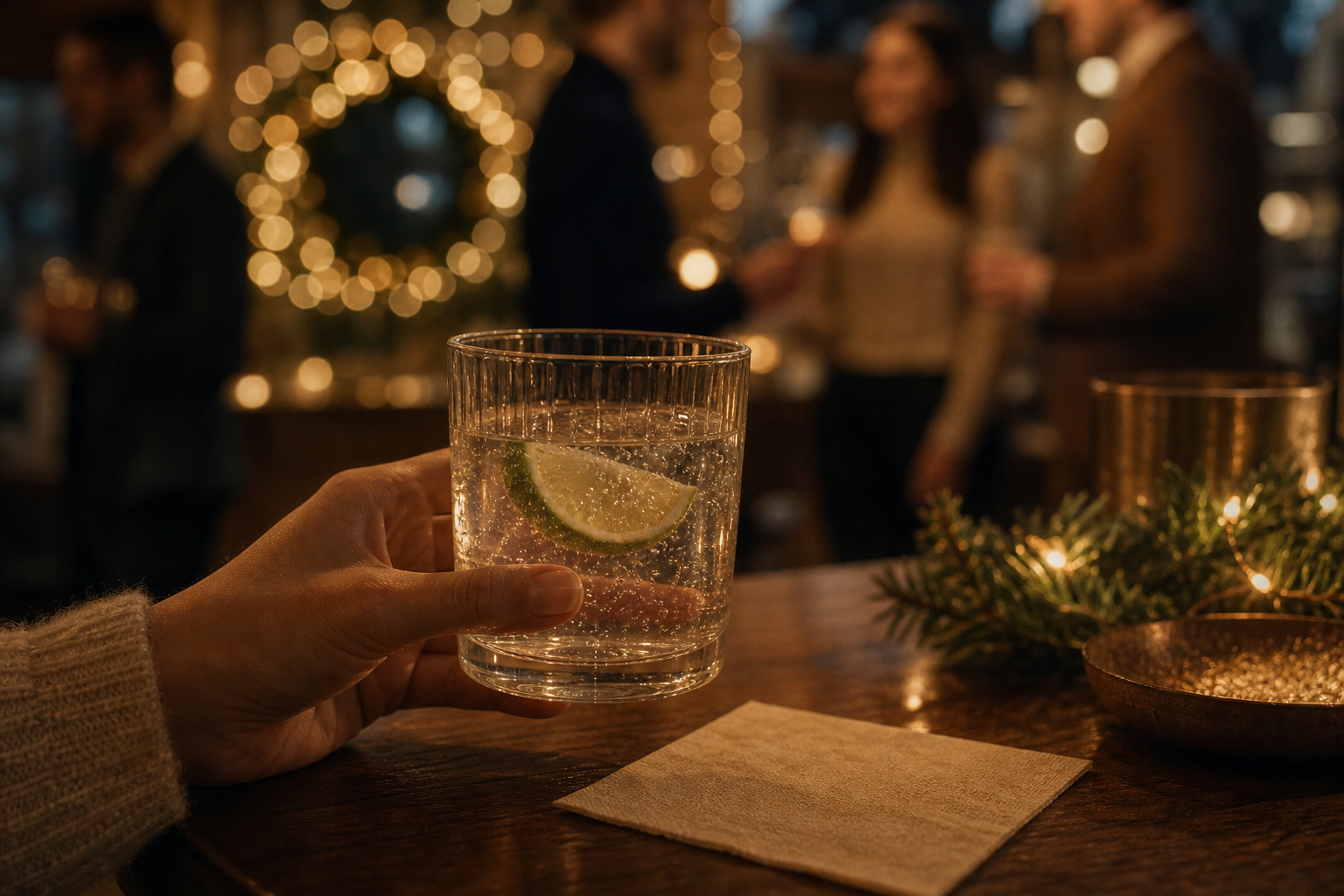
- Set a number before you arrive. Deciding "two drinks tonight" while you're still in the car is far easier than negotiating with yourself after the second pour, when the reward loop is already running.
- Eat a real meal first. Food slows alcohol absorption, which means fewer cravings triggered by that early buzz. A handful of crackers at the appetizer table doesn't count.
- Alternate every drink with water or a non-alcoholic option, which is one of the ways people work on cutting the urge to drink. This cuts your pace in half without requiring you to stand around empty-handed, which is often the real discomfort.
- Aim for one drink per hour. For most adults, the liver processes roughly one standard drink in that window, though the exact rate varies with body weight, sex, and other factors. Matching that general pace keeps blood alcohol from stacking.
- Pick something you actually want to sip slowly. A cocktail you enjoy tasting lasts longer than a beer you're drinking out of habit.
- Give yourself an exit plan. Knowing you can leave at 10 p.m. removes the pressure to keep drinking just because the party is still going.
- Talk to people, not your glass. Conversations give your hands and your attention something to do. When you're genuinely engaged with someone, the urge to refill fades into the background.
None of these require announcing your intentions or skipping the event. They work because they interrupt the automatic pattern at specific, predictable moments instead of relying on a vague resolution to "take it easy."
Handling Common Holiday Scenarios
Each holiday gathering has its own version of drinking pressure. Here's how to handle the ones that trip people up most.
Scenario | Why It's Tricky | What Works |
|---|---|---|
Thanksgiving Dinner | Relatives refill your glass without asking; saying no feels like rejecting the meal | Keep a non-alcoholic drink in hand at all times; use "I'm driving later" to shut down pushback |
Office Holiday Party | Open bar plus professional anxiety leads to overcorrecting with alcohol | Tell one coworker your plan for quiet accountability; order your own drinks to control pour size |
New Year's Eve | The midnight toast feels non-negotiable, and momentum builds all night | Hold one glass of champagne for the countdown; nurse a club soda the rest of the evening |
Hosting at Home | A half-empty glass in your own kitchen is absurdly easy to refill | Batch a signature mocktail alongside what you're serving; stay busy playing bartender |
Thanksgiving Dinner
Uncle Dave refills your wine glass every time he walks past, and saying no feels like rejecting the meal itself. The simplest counter: keep a non-alcoholic drink in your hand at all times. A sparkling water with lime looks enough like a cocktail that most relatives won't comment. If someone insists, "I'm driving later" shuts down the conversation without inviting follow-up questions.
The Office Holiday Party
Open bars and professional anxiety are a rough combination. Tell one coworker your plan beforehand. Having a single person who knows you're sticking to two drinks creates quiet accountability without a public announcement. Order your drinks at the bar yourself so no one else controls the pour size.
New Year's Eve
The midnight toast feels non-negotiable, and it basically is. So plan for it. Hold a single glass of champagne for the countdown and nurse a club soda the rest of the night. One toast at midnight is a ritual; the six drinks before it are just momentum.
Hosting at Home
When you're the one pouring, you control everything except the fact that a half-empty glass in your own kitchen is absurdly easy to refill. Batch a signature mocktail alongside whatever you're serving. You'll be too busy playing bartender to notice you're not drinking, and guests rarely track the host's glass.
What Mindful Drinking Actually Looks Like
Mindful drinking isn't a program or a set of rules you follow to the letter. It's a way of paying attention. You notice what you're drinking, why you reached for it, and whether the next one is something you actually want or just the path of least resistance.
The practice is lighter than it sounds. Before you walk into a party, take a few slow breaths in the car or on the sidewalk. That brief pause lowers the baseline anxiety that often drives the first drink to disappear in three minutes flat. Once you're inside, try actually tasting what's in your glass. The temperature, the smell, whether you even like it. Most people at holiday parties couldn't describe the flavor of the drink they're holding because they stopped noticing it two sips in.
Between drinks, check in with a simple question: "Do I want another one, or do I want to feel like I'm participating?" If the real answer is participation, a sparkling water accomplishes the same thing.
The point isn't perfection. It's inserting a small gap between impulse and action so the decision stays yours.
When Willpower Alone Is Not Enough: Prescription Options
Behavioral strategies work well for plenty of people. But a six-week stretch of back-to-back gatherings, open bars, and family tension is a different kind of challenge than a single Friday night. When triggers are that constant, willpower alone can start to feel like bailing water out of a boat with a slow leak.
That's where medication to cut back on alcohol enters the picture. Naltrexone is an FDA-approved medication that blocks the euphoric and rewarding feeling associated with drinking. It works by interrupting the endorphin-driven reward loop that makes holiday parties so good at keeping your glass full, and following a proper naltrexone dosing guide helps make sure it works as intended.
You take it, go to the party, and the drink in your hand just matters less. The pull to refill weakens because your brain isn't getting the reinforcement it expects. For someone who has tried pacing, water tricks, and exit plans and still ended up three drinks past their limit by 9 p.m., that pharmacological support can be the missing piece, especially once you understand the naltrexone timeline for when effects typically kick in.
Keeping It Private: What to Know About Confidential Treatment
One of the biggest reasons people hesitate to get help with their drinking isn't cost or effort. It's the worry that someone will find out. A boss, an insurer, a parent. That concern is normal, and the law is actually on your side here.
Federal regulations under 42 CFR Part 2 give substance use disorder treatment records a layer of confidentiality that goes beyond standard HIPAA protections. In most cases, these records cannot be shared with anyone, including other healthcare providers, without your explicit written consent. They also can't be used against you in criminal or civil proceedings without consent or a court order.
Self-pay treatment adds another barrier. When you pay out of pocket instead of running it through insurance, understanding the naltrexone price without insurance helps you plan, and there's no claim record and no paper trail sitting in your benefits file. Your employer never sees it. Your plan administrator never processes it.
None of this is legal advice, and edge cases exist. But the combination of Part 2 protections and self-pay means that seeking help for your drinking can stay between you and your care team, which is how it should be.
How Onir Helps You Drink Less This Holiday Season
If the strategies in this article sound useful but you know from experience that tips alone won't carry you through six weeks of holiday parties, Onir can close the gap. We prescribe FDA-approved generic naltrexone hydrochloride 50 mg tablets through a licensed U.S. clinician, and the medication ships to your door in plain, unmarked packaging. No waiting rooms, no insurance paperwork. Because medication is just one part of Onir, you also get ongoing coaching and behavioral support built into the program.
Getting started takes about a minute. A free 60-second quiz tells you whether Onir might be a fit, followed by a $19.99 clinician review that's refunded in full if you're not approved. From there, what Onir costs runs $99 a month, billed as $297 every 90 days, with medication and clinician care included. Most members notice the pull of alcohol weakening within 10 to 14 days, according to Onir member reviews, which means starting now puts you ahead of New Year's Eve.
Because Onir is self-pay, there's no insurance claim record. We never contact your employer or your primary care doctor unless you ask us to. The entire program runs through a secure dashboard where you can message your care team anytime, get refills handled automatically, and adjust your plan as your goals change. That kind of ongoing support matters when December keeps throwing gatherings at you and you'd rather not face each one alone.
Onir is available in all 50 states. If you want a prescription option in place before the next party on your calendar, it's worth reading what naltrexone user reviews report, then take the quiz at onirhealth.com and have medication in hand within about a week.
Final Thoughts on Holiday Drinking and How to Handle It
You don't need to skip every party or swear off alcohol completely to have a better holiday season. A little planning, some self-awareness, and the right support if you need it go a long way. The goal is waking up in January feeling like December was actually yours.
FAQ
Is there a prescription option to help you drink less without going to rehab?
Yes. Naltrexone is an FDA-approved medication that blocks the rewarding feeling alcohol produces, and it can be prescribed through telehealth without an in-person visit or rehab program. Onir prescribes generic naltrexone 50 mg tablets online, with medication shipped to your door in unmarked packaging. The entire process starts with a free 60-second quiz and a $19.99 clinician review.
Oar Health vs Ria Health vs Onir for cutting back on alcohol during the holidays?
All three are telehealth options for reducing drinking with medication support, but they differ in pricing, structure, and feel. Onir costs $99 a month (billed as $297 every 90 days, medication and clinician care included), operates on a self-pay basis with no insurance billing, and ships a 90-day supply of FDA-approved generic naltrexone in plain packaging. If discretion and a straightforward, self-pay model matter to you heading into the holiday season, Onir is worth comparing side by side.
What tools can you use to cut back on drinking while keeping it private from your employer?
Self-pay telehealth programs like Onir are built for this. Because Onir doesn't bill insurance, there's no claim record in your benefits file and no paper trail your employer or plan administrator can see. Substance use treatment records also carry extra federal protections under 42 CFR Part 2, meaning they generally can't be shared with anyone without your written consent.
Is Blackout Wednesday really the biggest drinking day of the year in the USA?
It's consistently in the conversation. The night before Thanksgiving rivals New Year's Eve and Christmas Eve for the top spot among the biggest drinking days of the year in the U.S., with roots in college students returning to hometown bars. Along with Christmas and New Year's Eve, these three dates account for the heaviest social drinking pressure and the sharpest spikes in alcohol-related traffic fatalities during the holiday season.
How do I set a realistic plan to drink less at holiday parties?
Pick a specific number of drinks before you arrive, eat a full meal beforehand, and alternate every alcoholic drink with water or a non-alcoholic option. Aiming for one drink per hour matches the pace your liver can process, and having an exit time in mind removes the pressure to keep going just because the party is still running. If you've tried behavioral strategies in past holiday seasons and still ended up past your limit, adding a prescription option like naltrexone can interrupt the reward loop that makes those crowded, open-bar nights so hard to manage.
What are the top 5 drinking days of the year in the USA?
The heaviest drinking days in the U.S. typically include Thanksgiving Eve (Blackout Wednesday), New Year's Eve, Christmas Eve, the Fourth of July, and St. Patrick's Day. Thanksgiving Eve and New Year's Eve consistently compete for the top spot, with Christmas Eve close behind. These days concentrate the most social pressure, open bars, and cultural expectation to drink.
Can naltrexone help you drink less at holiday parties without quitting entirely?
Yes. Naltrexone blocks the endorphin-driven reward that makes each drink reinforce the next, so alcohol simply matters less while you're at a gathering. You can still have a drink if you choose to, but the pull to keep refilling weakens. Most people on naltrexone notice that shift within 10 to 14 days of starting.
What is the second biggest drinking day of the year after New Year's Eve?
Thanksgiving Eve, widely known as Blackout Wednesday, is usually cited as the closest rival to New Year's Eve for the top spot among the biggest drinking days of the year in the U.S. Christmas Eve also ranks high, and depending on the data source, any of these three can trade places in a given year.
Should I take naltrexone every day during the holidays or only before parties?
Most clinicians prescribe naltrexone as a daily medication so it's already working when an unexpected trigger or last-minute invitation comes up. The holiday season is unpredictable enough that daily dosing tends to be more reliable than trying to time it around specific events. Your Onir clinician can help you decide on the right approach for your goals.
Best way to handle holiday drinking pressure from family without making it awkward?
Keep a non-alcoholic drink in your hand at all times so no one tries to fill an empty glass. If a relative pushes, a simple "I'm driving later" or "I'm pacing myself tonight" usually ends the conversation without follow-up questions. You don't owe anyone an explanation for how much you drink.
How do holiday drinking statistics compare between Thanksgiving, Christmas, and New Year's Eve?
All three fall among the top 10 biggest drinking days of the year in the U.S., with roughly a third or more of traffic fatalities during these windows involving an alcohol-impaired driver. About 55% of Americans report drinking more than usual across this stretch. The sheer density of gatherings from late November through January 1 creates a cumulative effect that single-night statistics don't fully capture.
Does Onir show up on your insurance record if you use it over the holidays?
No. Onir is self-pay, so there's no insurance claim and no paper trail in your benefits file. Substance use treatment records also carry extra federal protections under 42 CFR Part 2, meaning they generally can't be shared without your written consent. One thing to know: a filled naltrexone prescription does appear in the national e-prescribing network, so a doctor pulling your medication history could see it, but nothing goes through insurance.
What's the fastest way to get naltrexone before the holiday season starts?
Onir's process starts with a free 60-second quiz, followed by a $19.99 clinician review that typically gets a response within 24 hours. Once approved, a 90-day supply ships to your door in plain packaging, and most people have medication in hand within about a week. Starting in early November puts you ahead of Thanksgiving Eve and every party after it.
Why does alcohol feel harder to control at holiday parties than when you're drinking at home?
At home, there are few external triggers reinforcing the next drink. At a party, social cues are constant: someone hands you a refill, a toast pulls the room together, music and laughter keep the energy high. Each of these cues fires your brain's reward loop again, making each subsequent drink feel almost automatic. The environment, not your self-control, is doing most of the work.
Can you only drink on holidays and still have a problem with alcohol?
Drinking only on holidays doesn't automatically mean there's a problem, but it's worth paying attention to what happens on those nights. If you consistently drink more than you planned, feel unable to stop once you start, or notice the pattern repeating every holiday season, the reward loop may be running the show. A free 60-second quiz at Onir can help you figure out whether medication support makes sense for your situation.
The science behind Onir has been covered by
82%
drinking less within two weeks
30+ yrs
FDA-approved & clinically studied
1,200+
clinical studies behind it
$99
per month, shipped discreetly
In their words
“I started my medication about 8 days ago. I feel amazing. Don't really have any urges to drink alcohol.”
Keep reading
Resources
Cut Back on Thanksgiving Drinking This Year
Drink less at Thanksgiving without anyone noticing. November 2026 tips on pacing, deflection lines, and setting a limit before you arrive.
ReadResources
Why Holiday Drinking Adds Up This December
Wondering why holiday drinks add up so fast? Learn practical ways to cut back on Christmas drinking this November 2026.
ReadResources
A Sober New Year's Eve Guide for November 2026
Navigate New Year's Eve while drinking less with real tips on cravings, boundaries, and alcohol-free celebrations.
Read