Onir Resources
Drinking Alone: Signs It's Time to Cut Back
Not sure if your solo drinking habit is a problem? This October 2026 guide covers warning signs and simple ways to cut back.

By Justine Fowey, Onir Health Editorial Team
· Updated
You told yourself it was just a weeknight ritual. A glass to mark the shift from work mode to home mode. But somewhere along the way the ritual started running on autopilot, and now you're not sure if you enjoy it or need it. That gap between wanting a drink and needing one is smaller than it feels, and it's worth figuring out which side you're on.
TLDR:
- Drinking alone isn't automatically a problem; why you drink matters more than whether someone's in the room
- A 17-year study found solo drinking in young adulthood raises your risk of alcohol use disorder later in life
- Alcohol quiets anxiety tonight but triggers a rebound the next morning, a cycle called hangxiety
- Small changes like tracking drinks, setting dry days, and swapping to lower-strength options beat willpower alone
- Onir prescribes naltrexone online at $99/month, available in all 50 states, with self-pay billing that stays off insurance records
If this describes your evenings, a licensed clinician can review the rest privately. Takes 60 seconds.
What Drinking Alone Actually Means
"Drinking alone" can mean a lot of things. A glass of wine while you cook dinner is solitary drinking. So is finishing a bottle of whiskey in your room at 2 a.m. because you can't sleep. The phrase covers both, which is exactly why it causes so much confusion.
In clinical settings, researchers care less about whether someone else is in the room and more about why the person reached for the drink, how often it happens, and what follows. A beer on your porch after mowing the lawn sits in a different category than pouring three drinks every night to quiet your thoughts. The act looks the same from the outside. The function is completely different.
So if you've searched "is drinking alone bad," the straight answer is: it depends. Frequency, quantity, and motivation are better predictors of risk than the headcount. One quiet drink at home on a Friday doesn't carry the same weight as nightly solo drinking that you'd rather no one knew about. That distinction matters for everything that follows, especially if you want to drink less, not quit.
Why People Drink Alone
Some people drink alone because they genuinely enjoy it. A craft beer while cooking, a glass of something nice with a book. No audience, no performance. That's a preference, and it doesn't need defending.
But plenty of solo drinking starts for one reason and quietly becomes another. You open a beer to unwind after a long day, and that works, so you do it again. Then it becomes the thing you do at 6:15 every evening whether the day was hard or not. The ritual outlasts the reason.
That shift has a biological explanation. When you drink, your brain releases endorphins that reinforce the behavior. Over time, the loop tightens: stress hits, the thought of a drink surfaces almost before you've consciously registered it. The gap between wanting and doing is the reward loop running on autopilot.
Other motivations sit further down the scale. Loneliness, social anxiety, grief, boredom that feels heavier than it should. A smaller survey found that solitary drinkers are more likely to drink to cope with stress or tension. When alcohol becomes the primary tool for managing difficult feelings, the habit can accelerate in ways that are hard to see from the inside.
None of this makes you broken. It makes you human, running familiar neurochemistry, and learning how to drink less without quitting often starts with understanding that loop. The question worth sitting with isn't "why do I drink alone?" but "what is the drink replacing?"
The Psychology Behind Solitary Drinking
Researcher Kasey Creswell at Carnegie Mellon University has spent years studying what solitary drinking actually signals. Her framework treats the social context of drinking as a meaningful variable on its own, separate from how much or how often someone drinks.
Her longitudinal analysis, drawing on the Monitoring the Future study, followed participants for 17 years. The findings were clear: drinking alone during adolescence and young adulthood strongly increases risk for alcohol use disorder later in life, even after accounting for binge drinking, frequency of use, socioeconomic status, and gender. The risk was especially high for women.
A single behavior is not a diagnosis, though. Screening tools like the DSM-5 look at a cluster of patterns, not one habit in isolation, which is part of why alternatives to AA have gained traction for people who don't fit the traditional mold. What the research does suggest is that context deserves more attention than it typically gets in a doctor's office, where questions tend to focus on quantity and frequency alone. If you're wondering whether your solo drinking means something, the science says it's worth paying attention to, especially if it started young or has become your default way to manage how you feel.
Private clinician review, 60 seconds. See if Onir fits you.
Is Drinking Alone a Red Flag?
On its own, no. Drinking alone is common, and most people who do it occasionally aren't heading toward a problem. But certain patterns around solo drinking deserve real attention, because they tend to show up before things feel urgent.
Worth checking in on:
- You drink mainly to manage anxiety, sadness, or stress, and it's become your go-to response
- Your tolerance has crept up, meaning you need more to feel the same effect
- You hide how much you drink, or you'd feel uncomfortable if someone saw the empty bottles
- You've skipped activities you used to care about because staying in with a drink felt easier
- When someone mentions your drinking, your first instinct is defensiveness
No single item on that list is a diagnosis. Two or three together, showing up regularly, is a pattern worth taking seriously.
These changes happen gradually. Tuesday's glass of wine to take the edge off becomes Thursday's three glasses because one doesn't do much anymore, which is why some people look into tapering off alcohol at home before things escalate further. The line between "I enjoy this" and "I need this" rarely announces itself. If you're reading a list like this and mentally negotiating with it, that reaction alone is information.
Drinking Alone, Depression, and Hangxiety
Alcohol is a depressant, which sounds like it should mean it makes you sad. What it actually means is that it depresses your central nervous system, slowing neural activity and temporarily dialing down anxiety. That temporary relief is precisely the problem.
When you drink, alcohol enhances GABA, a neurotransmitter that calms brain activity, while suppressing glutamate, its excitatory counterpart. Your brain adapts in real time. Once the alcohol clears, the system overcorrects: GABA drops, glutamate surges, and you're left with a nervous system running hotter than before you picked up the glass. That rebound is what people call hangxiety, the wave of dread, racing thoughts, and sometimes outright panic that shows up the morning after.
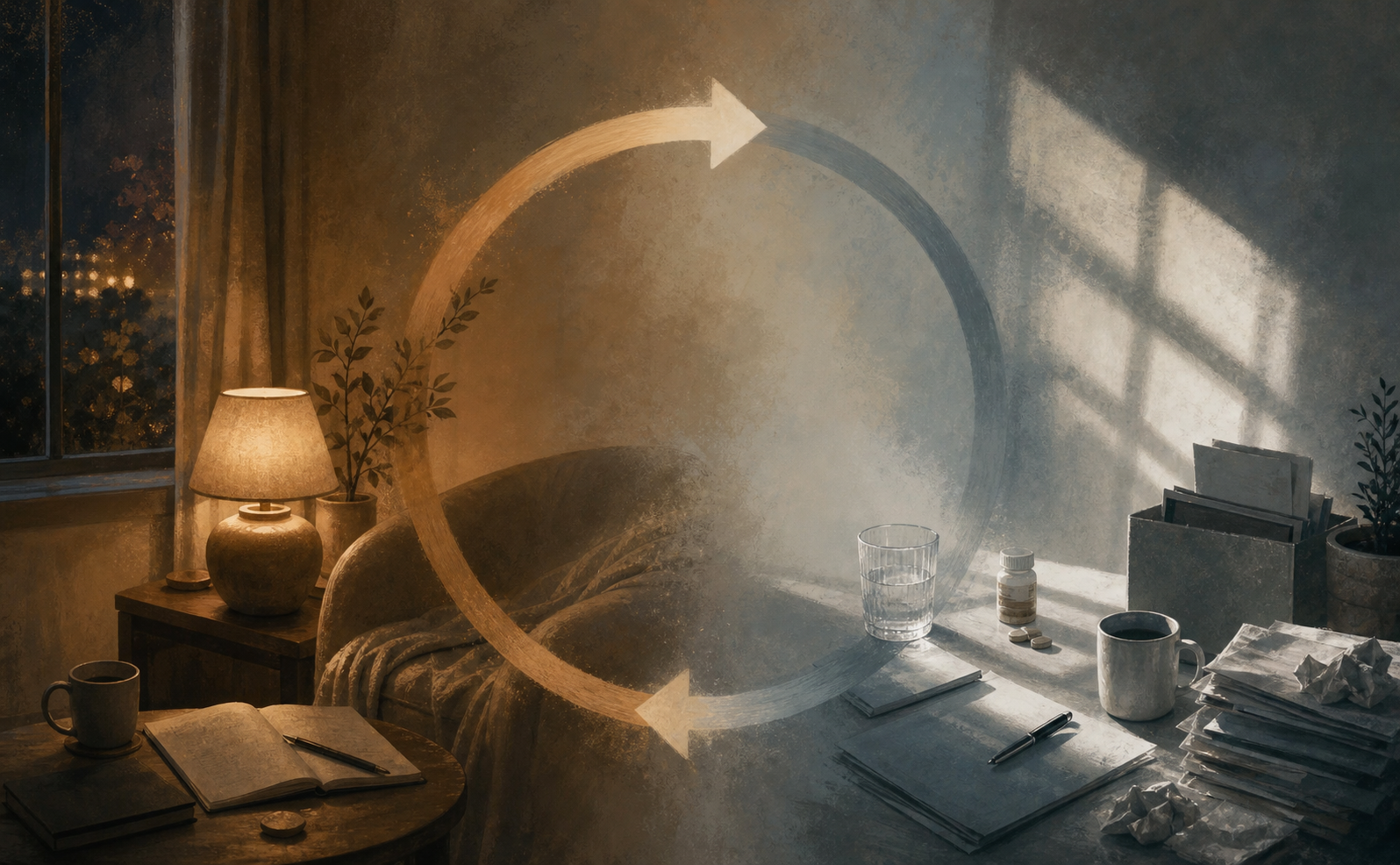
When you drink alone to manage a low mood, this cycle tightens without anyone noticing. There's no friend saying "maybe slow down," no social context pulling your attention outward. The drink quiets the feeling, the feeling returns worse, and the obvious solution looks like another drink. Alcohol suppresses anxiety tonight and manufactures more of it tomorrow.
If you're searching "is drinking alone a sign of depression," the more useful question might be whether drinking alone has become your primary way of coping with it.
Depression and alcohol feed each other in both directions. People with depressive symptoms drink more to manage them, and regular drinking worsens those symptoms over time. Solo drinking removes the last external check on that cycle. Nobody sees the pattern but you, and by the time you do, it can feel like the only tool you have.
Practical Ways to Cut Back on Weeknight Drinking
If nightly solo drinking has become your default, small structural changes tend to work better than willpower alone. These aren't dramatic interventions. They're friction, deliberately placed between the impulse and the pour.
- Track what you actually drink, not what you think you drink. The NIAAA's Rethinking Drinking program suggests a wallet card or app to log each drink in real time. Most people are surprised by the gap between their estimate and the number.
- Pick two or three alcohol-free days per week and scatter them. Tuesday, Thursday, Sunday works because it breaks the streak before momentum builds.
- Replace the ritual, not the drink. If you pour a glass at 6:30 because that's when you "switch off," the cue is the clock, not the alcohol. A walk, a sparkling water, ten minutes outside. The activity matters less than the interruption.
- Eat before you drink. Food slows absorption and makes the second glass feel less necessary.
- Go lower strength. Swap a 7% IPA for a 4% lager. You keep the ritual, cut the load roughly in half.
- Tell one person. A partner, a friend, a sibling. People who share their goal are more likely to stick with it. You're not asking for supervision. You're creating a single point of accountability outside your own head.
None of these require perfection. If you set three dry days and hit two, that's still two nights your body got a break it wasn't getting before.
When Self-Guided Strategies Are Not Enough
Sometimes the tips work for a while and then stop working. Or they never quite work at all. If you've tried tracking, swapping, and setting dry days but find yourself back at the same place most weeks, that's not a failure of discipline. It's a sign the habit has roots deeper than routine.
Professional support for drinking falls into three broad categories, and none of them require you to call yourself an alcoholic or commit to never drinking again.
Therapy
Cognitive behavioral therapy is one of the most studied approaches for changing drinking patterns. It helps you spot the triggers and thought loops that lead to a pour, then build alternative responses. If solo drinking is tangled up with depression or anxiety, a therapist can work on both at once.
Peer Support
Groups like SMART Recovery and Moderation Management offer structured community without requiring abstinence as the only acceptable goal. Both run online meetings, which matters if privacy is part of why you haven't reached out yet.
Medication Assisted Treatment
Three FDA-approved medications exist for alcohol use disorder: naltrexone, acamprosate, and disulfiram. Naltrexone helps you drink less by blocking the endorphin reinforcement that makes drinking feel rewarding. Acamprosate helps stabilize brain chemistry after someone has already stopped. Disulfiram creates an unpleasant physical reaction if you drink on it. A prescribing clinician can help determine which, if any, fits your situation.
How Naltrexone and Medication Assisted Treatment Work
The previous section named naltrexone, acamprosate, and disulfiram. Here's what actually happens when you take the one most relevant to cutting back.
Medication | How It Works | Can You Drink on It? | Best For |
|---|---|---|---|
Naltrexone | Blocks opioid receptors so alcohol's endorphin reward feels flat | Yes, designed to be taken while still drinking | People who want to drink less or stop gradually |
Acamprosate | Stabilizes brain chemistry (GABA/glutamate balance) after quitting | No, used after someone has already stopped | Maintaining abstinence and reducing post-quit cravings |
Disulfiram | Causes nausea and other unpleasant reactions if you drink | No, drinking on it triggers a physical deterrent | People committed to full abstinence who want a hard guardrail |
Naltrexone works by binding to opioid receptors in the brain before alcohol's endorphins can reach them. You can still drink on it. The difference is that the drink feels flatter, less like a reward and more like a glass of liquid. Over weeks, that diminished payoff loosens the automatic pull, and what naltrexone feels like day by day evolves as you stop thinking about the next pour because the last one didn't deliver much.
It's FDA-approved, non-addictive, and has been available for over 30 years, and a 90-day naltrexone timeline shows how the changes tend to unfold. Despite that, fewer than 10% of people with AUD receive treatment of any kind, medication or otherwise. The gap between what's available and what people actually use is wide, driven largely by stigma and the assumption that treatment means rehab, even though there's a path to quitting drinking without rehab.
How Onir Helps People Who Want to Drink Less
Onir prescribes medication to cut back on drinking online for people who want to drink less, stop entirely, or land somewhere in between. You start with a free 60-second quiz, then a $19.99 clinician review (refunded in full if you're not approved). Once a licensed clinician writes your prescription, a 90-day supply of FDA-approved naltrexone ships in plain, unmarked packaging. The cost is $99 a month, billed as $297 every 90 days, medication and clinician care included.
The whole process is self-pay, so treatment stays off your insurance records. Onir is available in all 50 states, and most members notice the pull of alcohol weakening within 10 to 14 days. If you've read this far and recognized yourself in some of these patterns, the quiz takes about a minute and costs nothing to find out whether naltrexone might be a fit, and if it isn't, there are alternatives to naltrexone worth looking into too.
Final Thoughts on Solo Drinking
One quiet drink at home can be perfectly fine. A nightly pattern you'd prefer nobody knew about is a different thing. Knowing the difference between those two is half the work, and the other half is doing something with that knowledge whenever you're up for it.
FAQ
Why do I feel like I need a drink even when I don't really want one?
That's the reward loop running ahead of your conscious decision. When you drink regularly, your brain releases endorphins that reinforce the behavior, and over time the craving fires automatically in response to familiar cues like time of day, stress, or boredom. Naltrexone works by blocking the opioid receptors those endorphins bind to, which is why medications like what Onir prescribes can quiet that pull within a couple of weeks for most people.
Oar Health vs Ria Health vs Onir for cutting back on alcohol?
All three are telehealth options prescribing medication for alcohol use disorder, but they differ in structure and cost. Ria Health typically involves breathalyzer tracking and coaching calls, while Oar Health and Onir both prescribe naltrexone online with a simpler workflow. Onir runs $99 a month (billed as $297 every 90 days, medication and clinician care included), ships in unmarked packaging, and is self-pay by design so nothing shows up on your insurance record.
Are there alternatives to AA for people who want to drink less but not quit completely?
Yes. SMART Recovery and Moderation Management both support reduction goals without requiring abstinence, and both run online meetings if privacy matters to you. On the medication side, naltrexone is FDA-approved and designed to work while you're still drinking, gradually weakening the rewarding feeling so the habit loosens on its own.
How does medication-assisted treatment for alcohol use disorder actually work?
Three FDA-approved medications exist: naltrexone, acamprosate, and disulfiram. Naltrexone blocks the endorphin reinforcement that makes drinking feel rewarding, so over time the automatic pull fades. Acamprosate stabilizes brain chemistry after someone has already stopped drinking, and disulfiram causes an unpleasant reaction if you drink on it. Fewer than 10% of people with AUD receive any treatment, largely because most don't realize medication is an option.
How can I cut back on weeknight drinking without it feeling like a big intervention?
Start with small structural changes: track every drink in real time (most people underestimate by a wide margin), pick two or three alcohol-free nights per week, and replace the ritual rather than white-knuckling through it. If those self-guided strategies keep stalling out, that's a signal the habit has a biological grip, and medication like naltrexone can reduce the craving at its source while you keep building better patterns.
Is drinking alone a sign of depression or just a personal preference?
It can be either, and the difference lies in why you're reaching for the drink. Enjoying a quiet glass of wine with a book is a preference; pouring three drinks every night to numb sadness or anxiety is a coping mechanism. If solo drinking has become your primary way of managing low mood, that pattern is worth paying attention to, especially since alcohol suppresses anxiety tonight and manufactures more of it tomorrow.
What is hangxiety and how long does alcohol-induced anxiety last the next day?
Hangxiety is the rebound anxiety, racing thoughts, and sometimes outright dread that shows up the morning after drinking. It happens because alcohol enhances calming GABA activity and suppresses excitatory glutamate while you drink, then your nervous system overcorrects once the alcohol clears. For most people the worst of it lasts 12 to 24 hours, though regular drinkers may feel a low-grade version lingering into the second day.
Can moderate alcohol use cause depression over time?
Yes. Even moderate regular drinking can worsen depressive symptoms over time because alcohol disrupts the balance of neurotransmitters your brain relies on to regulate mood. The cycle is self-reinforcing: you drink to feel better, the rebound makes you feel worse, and the obvious next step looks like another drink. If you notice your mood consistently dipping on days after you drink, that's a signal worth taking seriously.
Should I quit drinking entirely or just try to cut back?
That depends on your goals and where you are physically. Many people do well with reduction rather than full abstinence, and FDA-approved medications like naltrexone are designed to work while you're still drinking by weakening the rewarding feeling over time. Onir's clinicians build a plan around whatever goal you set, whether that's fewer weeknight drinks, longer breaks, or stopping altogether.
Is drinking alone a sign of alcoholism or alcohol use disorder?
Drinking alone by itself is not a diagnosis. Clinical screening tools like the DSM-5 look at a cluster of patterns: rising tolerance, hiding your intake, skipping activities you used to enjoy, and drinking specifically to manage difficult emotions. A 17-year longitudinal study did find that solo drinking in young adulthood raises the risk of alcohol use disorder later, so if several of those patterns show up alongside regular solo drinking, it's worth talking to a clinician.
Best way to stop drinking alone every night without going to rehab?
Start with structural friction: track every drink in real time, set two or three alcohol-free nights per week, and replace the ritual with something that fills the same cue (a walk, sparkling water, ten minutes outside). If those strategies keep stalling out, medication like naltrexone can quiet the biological pull at its source. Onir prescribes it online for $99 a month with no insurance paperwork, so you never need to step inside a clinic.
What does depression feel like when you stop drinking?
In the first few weeks, many people experience mood dips, irritability, and disrupted sleep as their brain chemistry recalibrates after relying on alcohol to regulate it. This is sometimes called post-acute withdrawal, and it can feel confusingly like the depression you were drinking to manage. For most people these symptoms improve within a few weeks, but if they persist, working with a clinician, whether through a service like Onir or your own doctor, can help determine if additional support is needed.
I hate drinking alone but I keep doing it—what's going on?
That tension between wanting to stop and doing it anyway is the reward loop outrunning your conscious decision-making. Your brain has learned that alcohol reliably delivers a hit of endorphins in response to stress, boredom, or a specific time of day, and the craving fires before you've fully thought it through. Naltrexone works by blocking those endorphin receptors so the drink stops delivering the payoff, which is why most Onir members notice the automatic pull weakening within 10 to 14 days.
Can I get naltrexone prescribed online without my doctor or insurance knowing?
Yes. Onir is a self-pay telehealth service, so treatment stays off your insurance records entirely, and Onir will never contact your primary care doctor unless you ask them to. Medication ships in plain, unmarked packaging. One thing to know: a filled prescription does appear in the national e-prescribing network (Surescripts), which doctors' offices can pull medication histories from, so it may show up if a provider runs that report.
How do I know if my solo drinking has crossed the line from habit to problem?
A few honest questions tend to clarify things: Are you drinking to manage specific emotions like anxiety, loneliness, or sadness? Has your tolerance crept up so that one drink no longer does what it used to? Would you feel uncomfortable if someone saw how much you actually drink? No single yes is a diagnosis, but two or three showing up regularly is a pattern worth acting on, and a free 60-second quiz at Onir can help you figure out whether medication support makes sense for your situation.
The science behind Onir has been covered by
82%
drinking less within two weeks
30+ yrs
FDA-approved & clinically studied
1,200+
clinical studies behind it
$99
per month, shipped discreetly
In their words
“I set one alarm for 5 p.m. and stopped thinking about it. Three weeks later the second glass just wasn't interesting anymore. No willpower involved.”
Individual results vary.
A quieter next step, when you want one
If practical changes have not been enough, a licensed clinician can review the rest privately. It doesn't commit you to anything.
60 seconds · 11 questions · Fully refunded if you're not approved