I've spent most of my career sitting across from healthy, successful people who simply want to drink a little less. Not the version you see in movies. Regular people. Nurses, teachers, mothers, business owners. People who eat well, exercise, and take their health seriously, and who've quietly decided that the nightly glass or two no longer fits the life they want.
Almost all of them say some version of the same thing: “There's nothing really wrong. I'd just feel better if I drank less.” And they're right. Cutting back is one of the single best things you can do for your sleep, your weight, your heart, and how many good years you get. You don't need a problem to want that.
They tell me they've tried everything. Dry January. The “only on weekends” rule. Switching from wine to seltzer. Counting drinks in their head, promising themselves tonight will be different, then feeling that quiet drop in the stomach the next morning when it wasn't. If you've done this dance, you already know it isn't about wanting it badly enough. You want it plenty.
Wanting to drink less isn't a confession. It's one of the healthiest decisions you can make.
Here's the part nobody told you: if every attempt to “just cut back” has let you down, that is not a character flaw. It's biology. Every drink chemically reinforces the next one, building a loop that lives in your brain's reward system, not in your willpower. Telling someone to try harder is like telling them to blink less.
Over years and hundreds of drinks, alcohol trains the brain to expect a reward and to crave it on schedule. That's why the 5 o'clock pull feels physical, and why the people with the most discipline in every other part of their lives often struggle with this one. It was never a measure of your strength. It was chemistry doing exactly what chemistry does.
The tool I actually reach for
There is a medication that interrupts that loop. It's been FDA-approved for more than 30 years, and it's the tool I trust for exactly this. Taken as a small daily pill, it quiets the urge before it starts, so the fourth glass simply stops calling your name. You can use it to cut back, or to stop completely. That choice stays yours.
Getting started is a one-time $50 physician assessment so a licensed doctor can confirm it's the right fit for you. If it isn't, the fee is refunded. Full pricing is below, but I want it on the table early.
The company that makes getting it simple is called Onir. No clinic waiting rooms, no meetings, no announcing anything to anyone. You answer a few private questions, a licensed physician reviews whether it's right for you, and if it is, it ships to your door in a plain package.
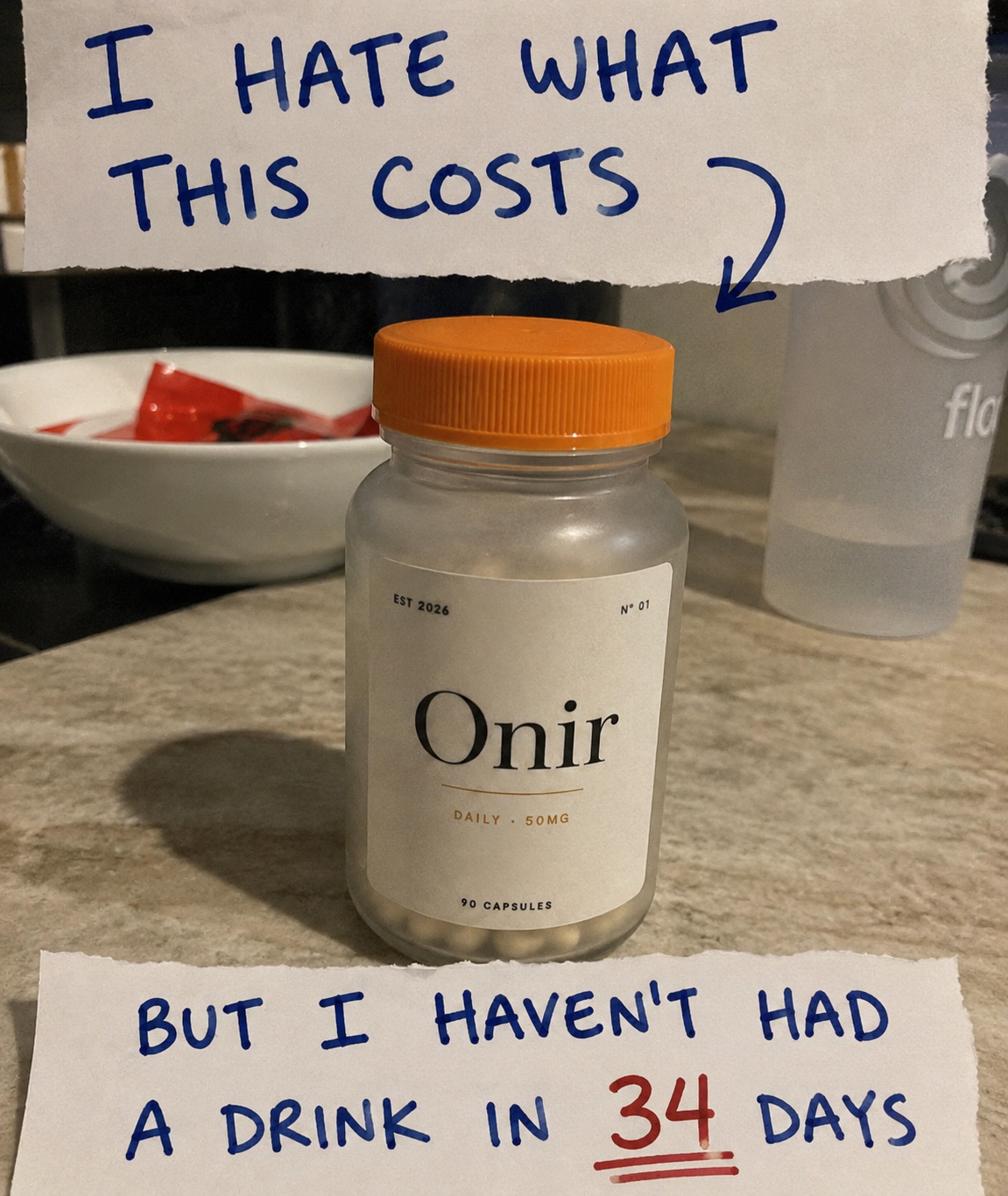
I won't oversell it. It isn't magic and it isn't for everyone. But in my patients, 73% are drinking less within the first two weeks. I've written more prescriptions for it this past year than in any year before. Some for people cutting back, some for people stopping for good.
This was never about willpower. It's just biology, and biology is something we can work with.
So why have you never heard of it?
This is the question I get most, and it's a fair one. If this works so well, why isn't it advertised during the evening news like every other medication?
The honest answer comes down to money. The medication has been around for decades, which means its patent expired long ago and it's now inexpensive and generic. There's no blockbuster profit in it, so no drug company has any reason to spend millions marketing it to you or sending reps to your doctor's office. The medicines you see advertised constantly are almost always the new, expensive, still-patented ones. This one quietly missed that machine.
I find that reassuring, not alarming. You're not looking at some new compound with an unknown track record. You're looking at a medication that has been studied and prescribed for more than 30 years, one that simply never had a marketing budget behind it. Its lack of hype is exactly why so few people know it exists, and it's a big part of why I trust it.
What the first few weeks actually feel like
Most people expect a dramatic before and after. It's usually quieter than that, and better for it. The change my patients describe most often isn't a burst of motivation. It's an absence. The 6 o'clock thought that used to arrive on its own simply doesn't show up. The bottle stays in the fridge and they realize at bedtime they never once thought about it.
One patient, a 52-year-old teacher, told me she'd spent twenty years believing she lacked discipline. Three weeks in, she called me almost annoyed. “That's it? I just… don't want it?” She had braced for a fight that never came. That “weirdly anticlimactic” feeling is, honestly, the whole point. You get to stop negotiating with yourself every single evening and get your energy back for the parts of life that actually matter.
You stay in control the entire way. You decide the goal, whether that's fewer drinks, alcohol only on certain nights, or none at all. A licensed physician checks in, adjusts if needed, and is there if you have questions. Nothing about it requires you to label yourself, join anything, or explain yourself to a single person in your life.
If any of this sounds like you, if drinking less has been quietly on your mind, do the one thing my patients wish they'd done sooner. Take a few minutes to find out if Onir is a fit. It's private, it's free, and it doesn't commit you to anything.
See if Onir is right for you
A 60 second quiz, reviewed by a licensed physician.